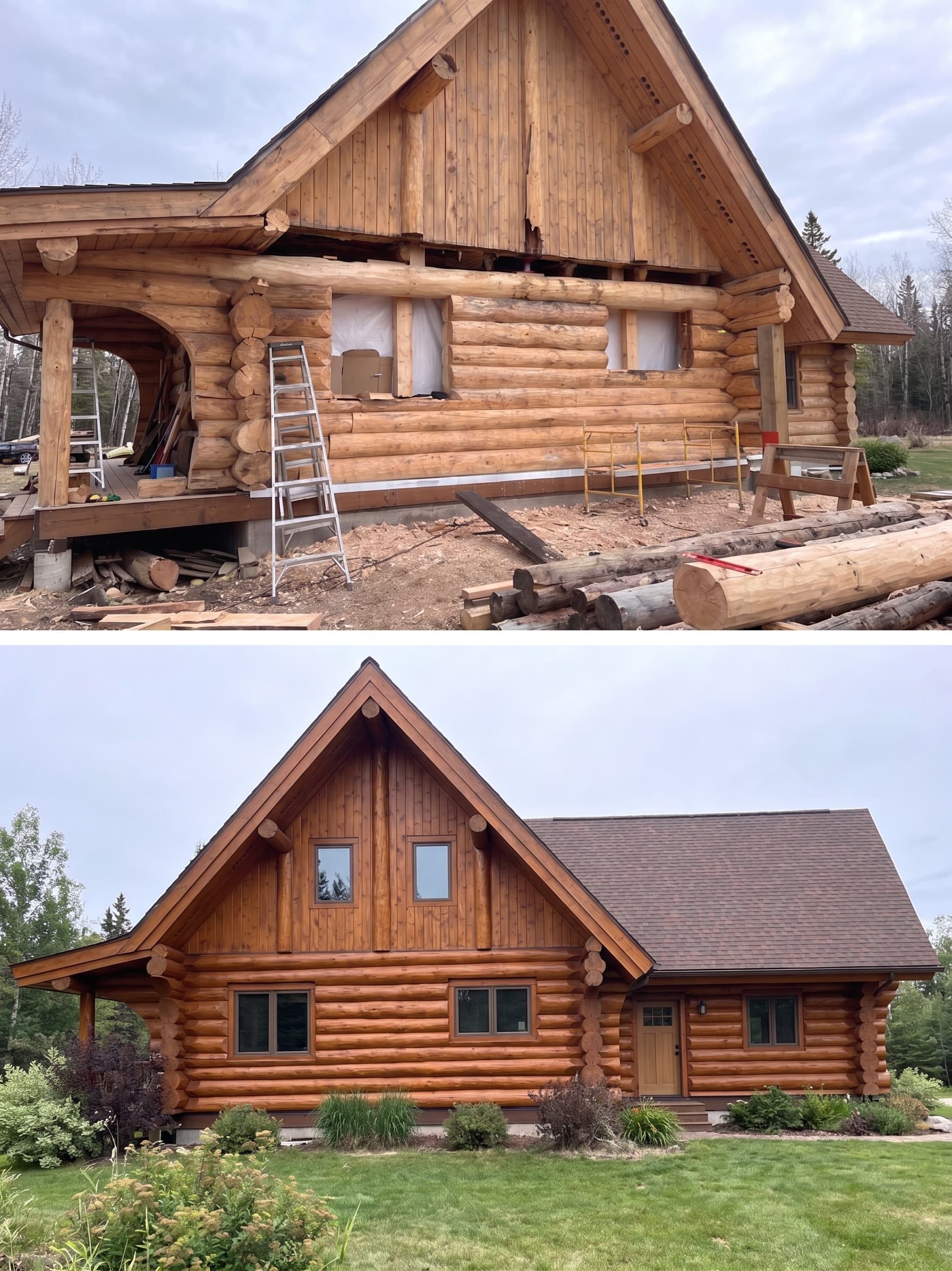
"Every 3 to 7 years" is the answer you'll get from most sources, and it's technically true and mostly useless. A log home doesn't age uniformly. The wall taking full afternoon sun is on a completely different clock than the wall that never sees direct light.
Here's how we actually think about it on a house call.
It's Not One Schedule, It's Four
Every log home has four exposures, and they degrade at different rates:
- South and west walls take the heaviest UV load. Expect to need a maintenance coat every 2–3 years, even if the full system is rated for longer.
- North and east walls dry slower and see less direct sun. These can often go 5–7 years before needing attention.
- Corners and log ends fail first on every exposure. End grain absorbs moisture and UV faster than the flat face of a log.
- Areas under eaves and overhangs are protected from rain but not from UV. Don't assume "sheltered" means "fine."
If you're treating your whole house as one project on one calendar, you're either restaining walls too early or leaving others exposed too long.
The Water-Bead Test
This takes two minutes and tells you more than a calendar ever will.
On a dry day, splash a cup of water against the wall in a few spots on each exposure. Watch what happens:
- Beads and rolls off — the finish is still protecting the wood. You're fine.
- Soaks in and visibly darkens the wood — the finish has failed at that spot, even if it still looks okay from a distance. It's time.
Run this test on all four sides separately. It's common to find one wall that needs attention two or three years before the others.
Why the Interval Isn't Fixed
The 3–7 year range assumes a properly prepped, breathable, water-based system with UV inhibitors. Three things shrink that window:
- Oil-based stain. It traps moisture instead of letting the log breathe, which shortens the finish's working life regardless of what the label promised. We cover why this matters in why log stain fails.
- Inadequate surface prep. Stain applied over the old failing coat, or over wood that wasn't properly cleaned and opened, doesn't bond the way it's supposed to. It looks fine on day one and fails within a season.
- Skipping the maintenance coat. A light maintenance coat on high-exposure walls at year 2–3 is far cheaper and faster than waiting for full failure and doing a complete strip-and-restain at year 5.
Maintenance Coat vs. Full Strip-and-Restain
These are not the same job, and a lot of homeowners pay for the expensive one when the cheap one would have worked:
- Maintenance coat: a light cleaning and a single fresh coat over a finish that's still mostly intact. Fast, inexpensive, and it's what keeps you on the long end of the 3–7 year range.
- Full strip-and-restain: the finish has failed broadly enough that it needs to come off entirely (typically via media blasting) before a full two-coat system goes back on. This is the job you're trying to avoid by catching things at the maintenance-coat stage.
When Restaining More Often Than Expected Is Actually a Red Flag
If a wall is failing well under two years no matter what you put on it, the problem usually isn't the stain. It's what's underneath. Wood that's already compromised by moisture or early rot won't hold a finish properly, no matter how good the product is. If that's what you're seeing, the fix isn't a different stain, it's an inspection.
Run the water-bead test on all four walls before you commit to a full restain. If one wall is failing and you're not sure why, book a house call. Log Doctor serves Saskatchewan, Manitoba, and Ontario.